- English
- French
- German
- Portuguese
- Spanish
- Russian
- Japanese
- Korean
- Arabic
- Greek
- German
- Turkish
- Italian
- Danish
- Romanian
- Indonesian
- Czech
- Afrikaans
- Swedish
- Polish
- Basque
- Catalan
- Esperanto
- Hindi
- Lao
- Albanian
- Amharic
- Armenian
- Azerbaijani
- Belarusian
- Bengali
- Bosnian
- Bulgarian
- Cebuano
- Chichewa
- Corsican
- Croatian
- Dutch
- Estonian
- Filipino
- Finnish
- Frisian
- Galician
- Georgian
- Gujarati
- Haitian
- Hausa
- Hawaiian
- Hebrew
- Hmong
- Hungarian
- Icelandic
- Igbo
- Javanese
- Kannada
- Kazakh
- Khmer
- Kurdish
- Kyrgyz
- Latin
- Latvian
- Lithuanian
- Luxembou..
- Macedonian
- Malagasy
- Malay
- Malayalam
- Maltese
- Maori
- Marathi
- Mongolian
- Burmese
- Nepali
- Norwegian
- Pashto
- Persian
- Punjabi
- Serbian
- Sesotho
- Sinhala
- Slovak
- Slovenian
- Somali
- Samoan
- Scots Gaelic
- Shona
- Sindhi
- Sundanese
- Swahili
- Tajik
- Tamil
- Telugu
- Thai
- Ukrainian
- Urdu
- Uzbek
- Vietnamese
- Welsh
- Xhosa
- Yiddish
- Yoruba
- Zulu
Why Most Buyers Confuse Siberian Ginseng Extract Powder with Real Ginseng—and Why It Matters?
I was on a call last month with a procurement manager from Germany who'd been sourcing Siberian Ginseng Extract Powder for three years. Or so he thought. His supplier had been sending material labeled "ginseng extract" with ginsenosides on the CoA. But Siberian ginseng—Eleutherococcus senticosus—doesn't contain ginsenosides. It contains eleutherosides. Different plant family. Different active compounds. Different applications. He'd been buying the wrong thing for three years and never knew.
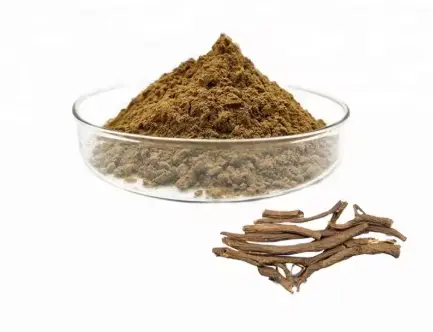
This confusion happens constantly. The name "Siberian ginseng" sounds like it should be related to Panax ginseng, but botanically they're not the same. Panax is Araliaceae, Eleutherococcus is also Araliaceae but a different genus . The active markers are eleutherosides B and E, typically standardized to 0.8% by HPLC . If your supplier's CoA shows ginsenosides, you're getting the wrong material.
The plant itself grows wild across northeastern China, parts of Russia, and Korea. The roots are harvested in spring and fall, dried, and extracted . Most commercial production happens in China—Shaanxi, Heilongjiang, Jilin provinces. The roots look like tangled woody pieces, nothing like the fleshy Panax roots. When processed into Siberian ginseng extract powder, it's a fine, brown to yellowish-brown powder with a characteristic bittersweet taste .
What's actually inside it matters more than the name. Eleutherosides B and E are the marker compounds used for standardization, but the root also contains polysaccharides that contribute to its biological activity . Unlike Panax ginseng which is stimulating in some contexts, eleuthero is classified as an adaptogen—it helps the body handle stress without pushing it in one direction or another .

The clinical data is limited compared to Panax, but there's some interesting work. A 2004 randomized trial with 20 elderly patients (65+ years) gave 300 mg/day of dry extract for 8 weeks. The group receiving eleuthero showed significant improvement in social functioning scores at 4 weeks compared to placebo. Seventy percent of those on eleuthero correctly guessed they were on active therapy versus 20% on placebo. No adverse events occurred, and no interactions with digoxin or blood pressure medications were observed .
Preclinical research suggests neuroprotective effects, potential blood sugar modulation, and immune stimulation . Animal studies indicate eleutheroside B and isofraxidin protect neurons from damage, and polysaccharides show immunomodulatory activity . But human studies are limited, and the quality varies widely depending on the source material and extraction method.
Traditional Chinese medicine uses eleuthero—called ci wu jia—for "invigorating qi, strengthening the spleen, and calming the mind" . It's indicated for fatigue, poor appetite, kidney deficiency, and insomnia . The Chinese Pharmacopoeia includes it, with both powdered root and extract preparations officially recognized . The daily dose for dried root is 2-3 grams, for concentrated extract 300-400 mg, typically taken for 6-8 weeks followed by a 1-2 week break .
In dietary supplements, Siberian ginseng extract powder appears in capsules, tablets, and liquid extracts targeting energy, stress adaptation, and immune support. Some suppliers offer organic versions, like MartinBauer's Organic Eleuthero Root Powder . Others provide standardized extracts with 0.8% eleutherosides B+E by HPLC, suitable for functional foods and beverages . The CAS number is 118-34-3 .
The safety profile is relatively clean. Side effects are rare and usually occur at high doses—insomnia, anxiety, mild gastrointestinal issues . People with rheumatic heart disease should be cautious, as some reports suggest it might affect blood pressure . No significant drug interactions have been confirmed, but in vitro studies suggest eleutherosides may inhibit CYP2C9 and 2E1, potentially affecting drugs metabolized by these enzymes . One case report raised concern about digoxin levels, though a clinical trial found no interaction in elderly patients on digitalis . Breastfeeding women should avoid it due to lack of safety data .
Here's what procurement should verify. First, confirm the botanical source—Eleutherococcus senticosus, not Panax. Second, check standardization to eleutherosides B and E, typically 0.8% by HPLC . Third, request third-party lab verification of the full phytochemical profile. Fourth, review heavy metal and microbial testing. Fifth, ask about traceability—where were the roots harvested, when, how were they stored before extraction? Suppliers who can't answer these are probably buying spot material from traders.

A quality assurance director once told me: "I don't care if they call it ginseng. I care if the HPLC fingerprint matches the reference standard every time." That's the right approach. Names confuse. Data doesn't.
FAQ
1. Is Siberian Ginseng Extract Powder the same as Korean or American ginseng?
No. They're different plants entirely. Siberian ginseng is Eleutherococcus senticosus, while Korean and American ginseng are Panax species. The active compounds differ—eleutherosides in Siberian ginseng versus ginsenosides in Panax . They belong to the same plant family but different genera, and their applications in traditional medicine overlap somewhat but aren't identical.
2. What should I look for on a Certificate of Analysis for Siberian Ginseng Extract?
Look for standardization to eleutherosides B and E, typically 0.8% by HPLC . The botanical name should be Eleutherococcus senticosus. The powder should be fine, brown to yellowish-brown, with characteristic odor . Heavy metal limits should meet pharmacopeial standards. If the CoA lists ginsenosides instead of eleutherosides, you're looking at the wrong product.
3. What are the main applications for eleuthero root extract in supplements?
Energy support, stress adaptation, immune function, and general vitality . It's classified as an adaptogen—helping the body handle physical and mental stress. Some research suggests benefits for fatigue, social functioning in elderly patients, and potentially blood sugar modulation . It's used in capsules, tablets, liquid extracts, and functional foods.
4. How long does Siberian Ginseng Extract stay potent when stored properly?
Properly stored in sealed containers away from light, heat, and moisture, most extracts maintain stability for 2-3 years. Recommended conditions are cool, dry environments below 25°C. Always check the manufacturer's expiration date and storage guidelines on the Certificate of Analysis. If the powder clumps or darkens noticeably, degradation may have occurred.
5. Are there any drug interactions with eleuthero root powder?
Limited evidence exists, but caution is warranted. In vitro studies suggest eleutherosides may inhibit CYP2C9 and 2E1 enzymes, potentially affecting drugs metabolized by these pathways . One case report raised concerns about digoxin levels, though a clinical trial found no interaction in elderly patients on digitalis . Breastfeeding women should avoid use due to lack of safety data