- English
- French
- German
- Portuguese
- Spanish
- Russian
- Japanese
- Korean
- Arabic
- Greek
- German
- Turkish
- Italian
- Danish
- Romanian
- Indonesian
- Czech
- Afrikaans
- Swedish
- Polish
- Basque
- Catalan
- Esperanto
- Hindi
- Lao
- Albanian
- Amharic
- Armenian
- Azerbaijani
- Belarusian
- Bengali
- Bosnian
- Bulgarian
- Cebuano
- Chichewa
- Corsican
- Croatian
- Dutch
- Estonian
- Filipino
- Finnish
- Frisian
- Galician
- Georgian
- Gujarati
- Haitian
- Hausa
- Hawaiian
- Hebrew
- Hmong
- Hungarian
- Icelandic
- Igbo
- Javanese
- Kannada
- Kazakh
- Khmer
- Kurdish
- Kyrgyz
- Latin
- Latvian
- Lithuanian
- Luxembou..
- Macedonian
- Malagasy
- Malay
- Malayalam
- Maltese
- Maori
- Marathi
- Mongolian
- Burmese
- Nepali
- Norwegian
- Pashto
- Persian
- Punjabi
- Serbian
- Sesotho
- Sinhala
- Slovak
- Slovenian
- Somali
- Samoan
- Scots Gaelic
- Shona
- Sindhi
- Sundanese
- Swahili
- Tajik
- Tamil
- Telugu
- Thai
- Ukrainian
- Urdu
- Uzbek
- Vietnamese
- Welsh
- Xhosa
- Yiddish
- Yoruba
- Zulu
Why Is Kudzu Root Extract Referred to as "Gegen" and What Makes It a Multi-Target Botanical?
If you've been sourcing ingredients for cardiovascular health, metabolic support, or even alcohol management formulations, you've likely encountered Kudzu Root Extract. Known in traditional Chinese medicine as "Gegen" (葛根), the root of Pueraria lobata (Willd.) Ohwi has been used for millennia, with its first documented use appearing in Shennong's Herbal Classic around 200 CE . However, the conversation in modern nutraceutical and pharmaceutical labs has moved far beyond its historical applications. What's driving intense formulator interest is its exceptionally well-characterized profile of bioactive isoflavonoids—primarily puerarin, daidzin, and daidzein—which have been extensively studied for their cardiovascular, neuroprotective, and metabolic effects . For product developers, this isn't just another herbal extract; it's a clinically validated ingredient with documented mechanisms of action and a place in multiple pharmacopeias worldwide, including the Chinese Pharmacopoeia .
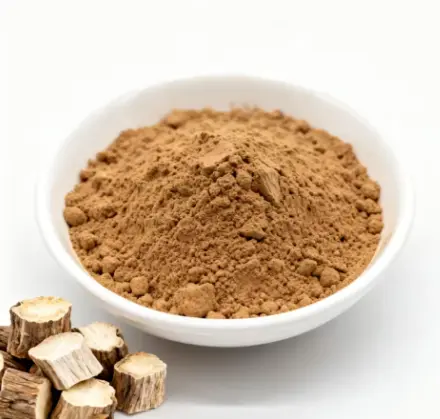
The journey to a high-quality Kudzu Root Extract begins with the source material and the precision of its processing. The plant is a climbing, semi-woody perennial vine that forms large fleshy root tubers up to 2 meters long and 18-45 cm in diameter, capable of reaching depths of 1-5 meters . It is widely cultivated in China, with wild and cultivated areas exceeding 0.4 million hectares and an annual output of over 1.5 million tons, ensuring a sustainable and scalable supply chain . Fresh kudzu root contains 15% to 34.2% starch, alongside its valuable flavonoid content . The primary bioactive markers—puerarin, daidzin, and daidzein—can be enriched by 7.75 to 27.51 fold through proper extraction and purification techniques such as AB-8 resin column chromatography . Modern extraction methods have advanced significantly, with options including water decoction, solvent extraction, ultrasonic-assisted extraction, microwave-assisted extraction, pressurized solvent extraction, ionic liquid-assisted extraction, supercritical CO₂ extraction, and macroporous resin adsorption, each with distinct advantages and disadvantages for yield, purity, and scalability . Water decoction, while traditional, remains relevant for industrial production due to its non-toxic nature, lower operational costs, and comparable yields to organic solvent methods . A high-quality extract will be standardized to specific marker compounds, with the industry increasingly focusing on puerarin content as a key quality indicator .
This standardization unlocks a remarkably broad spectrum of clinically supported applications. The most established use for Kudzu Root Extract is in cardiovascular and cerebrovascular health. Modern medical research demonstrates that its active ingredients excel at regulating blood circulation, reducing myocardial hypoxia, lowering blood pressure, and improving outcomes in conditions like coronary heart disease, angina, arrhythmia, myocardial infarction, heart failure, and cerebral ischaemia . In China, puerarin injection is currently recommended for the treatment of coronary heart disease, obstruction of retinal artery and vein, and sudden deafness . The mechanisms are complex and involve modulation of calcium, potassium, and sodium channels, modulation of α1 and β adrenoceptors, inhibition of NO, HO-1, MMP-2, TIMP-2, ROS, AGE, and collagen IV, as well as regulation of metabolic pathways such as NF-κB, PPARγ, and JAK/STAT . A significant body of research also supports its role in metabolic health, with studies demonstrating effects on lowering blood glucose, blood lipids, and treating non-alcoholic fatty liver disease and diabetes complications . The isoflavonoids, particularly puerarin, possess anti-hypercholesterolaemic, anti-platelet, anti-inflammatory, anti-oxidant, and hypoglycaemic properties .

Beyond cardiovascular and metabolic applications, Kudzu Root Extract has gained attention for its antidipsotropic (anti-alcohol abuse) activity. This is one of its most intriguing and historically validated uses, documented in traditional Chinese medicine for over a millennium . Research has demonstrated that a crude extract suppresses free-choice ethanol intake in ethanol-preferring animal models, and two of its isoflavones—daidzin and daidzein—have been identified as the primary active constituents responsible for this effect . Subsequent studies in rats and a small human trial with heavy drinkers confirmed that kudzu extract (puerarin) significantly reduced the number of beers consumed without affecting the urge to drink, with no reported side effects . The mechanism is thought to involve inhibition of aldehyde dehydrogenase 2 (ALDH-2) .
Emerging research points to additional applications. A 2021 clinical trial in postmenopausal women found that Kudzu Root Extract significantly reduced biomarkers of bone resorption (serum/urine CTX-I by up to 34%) and cartilage degradation (urine CTX-II by 17.4%), particularly with three-times-daily dosing, while also improving menopausal symptoms as measured by the Menopause Rating Scale . The extract was well tolerated across all dose regimens with no serious adverse events . Further laboratory studies have demonstrated that an isoflavonoid-enriched extract protects human umbilical vein endothelial cells against oxidative stress-induced apoptosis and mitochondrial damage, suggesting potential for vascular protection .

For procurement and quality assurance professionals, sourcing a premium Kudzu Root Extract requires a rigorous, science-led checklist. First, demand comprehensive standardization data. The Certificate of Analysis (CoA) must specify the content of key markers—particularly puerarin, daidzin, and daidzein—via validated HPLC methods . Second, verify the botanical source and nomenclature. This is critically important because multiple species are used under the name "kudzu," including Pueraria lobata (Willd.) Ohwi and Pueraria thomsonii Benth., and they contain different amounts of puerarin and other compounds . The species should be clearly stated, and voucher specimens should be available for authentication to ensure comparable and interpretable results . Third, insist on rigorous safety testing. Batch-specific assays for heavy metals, pesticides, and microbial contaminants are non-negotiable. The root is generally considered safe for most adults in small doses for short periods, but long-term safety data are limited, and use during pregnancy or breastfeeding is not recommended . Fourth, evaluate extraction technology and sustainability. The choice of extraction method—whether water decoction, solvent extraction, or advanced techniques like ultrasonic or supercritical CO₂—impacts both yield and environmental footprint . An integrated process that co-produces isoflavone extract, bioethanol, and crude lignosulfonate from the same raw material represents a sustainable, zero-waste approach that fully utilizes PLR components .
The market trend for Kudzu Root Extract is being propelled by robust scientific validation and expanding applications across cardiovascular, metabolic, bone health, and alcohol management categories. The global demand for its medicinal products is increasing due to its great medicinal values, with applications ranging from pharmaceutical preparations (including injectable forms in China) to dietary supplements . The future will likely see more standardized extracts with enhanced bioavailability, the development of clinically studied, patented extracts, and continued research into the distinct mechanisms of action of its individual isoflavonoids. As the industry moves toward higher and more specific standardization, suppliers who invest in human trials, transparent quality control, and sustainable processing technologies will lead the market. The integration of kudzu root utilization with biofuel production represents an economically profitable and environmentally friendly direction, with 1 kg of PLR potentially yielding 0.304 kg of isoflavone extract alongside other value-added products .

In summary, sourcing Kudzu Root Extract is a strategic investment in a clinically validated, multi-functional botanical with applications spanning cardiovascular protection, metabolic health, bone and cartilage support, menopausal symptom relief, and even alcohol management. Its potential is backed by thousands of years of traditional use and a robust, growing body of modern scientific evidence. Success hinges on partnering with a supplier who provides transparent analytical data, verifies species and origin, employs appropriate extraction technology, and understands the complex phytochemistry—particularly the critical role of puerarin, daidzin, and daidzein—that underpins its benefits. For brands aiming to lead in the cardiovascular, metabolic, and women's health spaces, this versatile root from the legume family offers a sophisticated and credible foundation for effective, research-backed products.
IF You Are Interested In The Products We Operate And Other Related Categories, Please Write To Us And Contact Us. At The Same Time, You Can Also Browse Our Website To Find The Products You Want. We Provide Customized Services And Look Forward To Establishing Cooperation With You.
Email:sales@greenherbbt.com