- English
- French
- German
- Portuguese
- Spanish
- Russian
- Japanese
- Korean
- Arabic
- Greek
- German
- Turkish
- Italian
- Danish
- Romanian
- Indonesian
- Czech
- Afrikaans
- Swedish
- Polish
- Basque
- Catalan
- Esperanto
- Hindi
- Lao
- Albanian
- Amharic
- Armenian
- Azerbaijani
- Belarusian
- Bengali
- Bosnian
- Bulgarian
- Cebuano
- Chichewa
- Corsican
- Croatian
- Dutch
- Estonian
- Filipino
- Finnish
- Frisian
- Galician
- Georgian
- Gujarati
- Haitian
- Hausa
- Hawaiian
- Hebrew
- Hmong
- Hungarian
- Icelandic
- Igbo
- Javanese
- Kannada
- Kazakh
- Khmer
- Kurdish
- Kyrgyz
- Latin
- Latvian
- Lithuanian
- Luxembou..
- Macedonian
- Malagasy
- Malay
- Malayalam
- Maltese
- Maori
- Marathi
- Mongolian
- Burmese
- Nepali
- Norwegian
- Pashto
- Persian
- Punjabi
- Serbian
- Sesotho
- Sinhala
- Slovak
- Slovenian
- Somali
- Samoan
- Scots Gaelic
- Shona
- Sindhi
- Sundanese
- Swahili
- Tajik
- Tamil
- Telugu
- Thai
- Ukrainian
- Urdu
- Uzbek
- Vietnamese
- Welsh
- Xhosa
- Yiddish
- Yoruba
- Zulu
Why Do Two Batches of St John's Wort Standardized Extract with the Same Specs Perform Completely Differently?
Had a procurement manager call me two weeks ago, frustrated. His company had been sourcing st johns wort standardized extract for a mood support formulation, and the first three batches worked fine. Batch four arrived with the same CoA—0.3% hypericin, brown-red powder, same specs—but when his QC ran the incoming test, the dissolution profile was off. The powder clumped. The color was slightly darker. And when they sent it out for third-party HPLC, the hyperforin content came back at 1.2% instead of the usual 3-4%. Same hypericin spec. Completely different phytochemical profile.
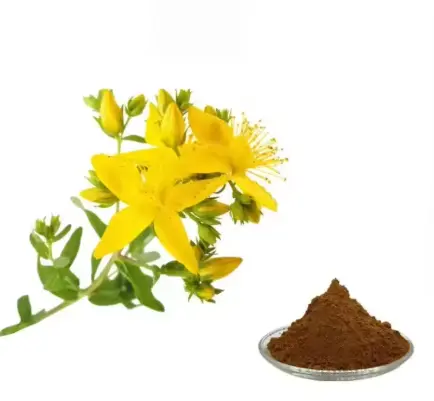
Here's the thing about hypericum perforatum extract that nobody tells you when you first start sourcing it. The flowers contain two main groups of active compounds—hypericin and hyperforin—and they have different stability characteristics, different biological activities, and different clinical implications. The Merck Manual notes that standardized extracts should contain 0.2 to 0.3% hypericin and/or 1 to 4% hyperforin . But if your supplier only tests for hypericin, you're flying blind. The hyperforin could be anywhere, and your product's efficacy goes with it.
The plant Hypericum perforatum grows wild across Europe, Asia, and parts of North America, flowering around late June—hence the name St. John's Wort, tied to the feast of St. John the Baptist . The flowering tops contain the biologically active ingredients, and harvest timing is critical. Too early, and the hyperforin content is low. Too late, and the delicate compounds start degrading in the field. Most commercial production now comes from cultivated sources in Eastern Europe and China, where growers can control harvest timing and drying conditions.

Commercial st johns wort standardized extract is typically produced through ethanol or methanol extraction of the dried flowering tops, followed by concentration and drying to a fine powder. The European Pharmacopoeia recognizes a st johns wort standardized extract 300mg grade as a pharmaceutical reference standard, stored at -20°C for laboratory use . For dietary supplement manufacturing, common specifications include 0.3% hypericin by UV-Vis, with loss on drying ≤5%, total ash ≤5%, and particle size 100% through 80 mesh .
What most buyers don't realize is that the hypericin number is just one part of the story. Hyperforin, which can constitute 3-5% of the extract, is more unstable and prone to oxidation during storage. ConsumerLab testing found enormous variation in hyperforin content across commercial products—up to 280 times difference between brands . That means two products both labeled st johns wort standardized extract could deliver completely different therapeutic effects. The 0.3% hypericin might match, but the hyperforin could be anywhere from negligible to 6%.
The clinical data is substantial but specific to certain extract types. Studies have shown that standardized extracts of St. John's wort in the dose range of 300 mg to 900 mg once daily are moderately effective for mild-to-moderate depressive symptoms . A 2017 meta-analysis of 27 studies with 3808 subjects found St. John's wort comparable to SSRIs in response and remission for mild-to-moderate depression, with lower discontinuation rates . The World Federation of Societies of Biological Psychiatry and CANMAT Taskforce guidelines state that St. John's wort monotherapy may be used for mild to moderate unipolar depression .

But those studies used specific extracts—usually standardized to both hypericin and hyperforin. ConsumerLab points out that taking a supplement with the right type and amount of St. John's wort extract appears as effective for mild-to-moderate depression as standard antidepressants, with fewer side effects . But 60% of products tested didn't contain expected amounts of key plant chemicals . That's a supply chain risk you can't afford.
The application range goes beyond mood support. Topical applications have shown potential for skin disorders, and some research suggests benefits for menopausal symptoms . A meta-analysis of 6 trials including 717 menopausal women found St. John's wort alone or in combination with other botanicals may help with menopausal symptoms, though more research is needed .
The safety profile comes with serious caveats. St. John's wort interacts with a wide range of medications through CYP3A4 enzyme induction and P-glycoprotein effects. Medscape lists 44 contraindicated drugs, including apixaban, atazanavir, darunavir, elvitegravir, irinotecan, maraviroc, nelfinavir, and warfarin . It should not be taken with any antidepressant medications . Photosensitivity is another concern—users should limit direct sun exposure . The Puritan's Pride label warns not to use in children under 18, and to discontinue use if rash occurs .
Pregnant and nursing women should avoid it due to lack of safety data . Before any surgical procedures, stop taking St. John's wort at least two weeks prior .
Technical specifications matter when sourcing. A supplier's Certificate of Analysis should include hypericin content by HPLC or UV (typically 0.3% minimum), hyperforin content (if relevant to your application), loss on drying ≤5%, total ash ≤5%, heavy metals within limits (total heavy metals ≤10ppm, lead ≤2ppm, arsenic ≤1ppm, cadmium ≤1ppm, mercury ≤0.5ppm) . Microbial specs should include total plate count ≤1000 CFU/g, yeast and mold ≤100 CFU/g, pathogens absent . Particle size should be consistent for your application—typically 100% through 80 mesh .
Packaging is usually in food-grade HDPE bags sealed into fiber drums with double polyethylene liners, stored in cool, dry conditions away from direct light. Some suppliers offer organic, kosher, or vegan certified options .
A quality assurance director once told me: "I don't need the lowest price. I need every batch to match the first one, and I need the paperwork to prove it when my auditor shows up." With st johns wort standardized extract, that means full HPLC fingerprinting showing both hypericin and hyperforin, batch after batch. The 0.3% number on the CoA is just the starting point.

FAQ
1. What does "standardized" mean in st johns wort standardized extract?
Standardization means the extract is processed to contain a guaranteed amount of specific marker compounds—typically 0.3% hypericin and/or 1-6% hyperforin . This ensures batch-to-batch consistency, but only if both markers are controlled. Some suppliers only standardize to hypericin, which doesn't capture the full phytochemical profile.
2. What are the main applications for hypericum perforatum extract in dietary supplements?
The primary application is mood support for mild-to-moderate depression, backed by clinical studies showing comparable efficacy to SSRIs with fewer side effects . Secondary applications include menopausal symptom relief, topical use for skin conditions, and occasional use for anxiety or seasonal affective disorder .
3. What's the difference between hypericin and hyperforin in st johns wort extract?
Hypericin and hyperforin are both active compounds but have different stability and activity profiles. Hypericin is more stable and easier to measure, historically used as the primary standardization marker. Hyperforin is more unstable but contributes significantly to antidepressant activity . ConsumerLab testing found hyperforin content varied 280-fold across commercial products, even when hypericin specs matched .
4. Are there serious drug interactions with st johns wort supplement standardization?
Yes, St. John's wort has more documented drug interactions than almost any other botanical. It induces CYP3A4 enzymes and P-glycoprotein, reducing effectiveness of dozens of medications including birth control pills, blood thinners like warfarin, HIV medications, cancer drugs, and immunosuppressants . It should not be taken with any antidepressant medications . Always verify drug interaction history before formulating.
5. How should st johns wort standardized extract powder be stored?
Store in sealed containers away from direct light, heat, and moisture. Recommended conditions are cool, dry environments below 25°C with relative humidity controlled. Hyperforin is particularly unstable and degrades with exposure to light and air. Properly stored, most extracts maintain stability for 2-3 years. The European Pharmacopoeia reference standard requires storage at -20°C .
6. What specifications should I look for when sourcing st johns wort extract?
Look for both hypericin (typically 0.3% minimum) and hyperforin (ask for actual content, typically 1-6%) verified by HPLC . Request third-party lab verification matching in-house data. Check heavy metals (total ≤10ppm), microbial specs, and loss on drying ≤5% . For specific applications, ask about particle size and solubility characteristics. Certifications like GMP, organic, kosher, or vegan may be required for your target market.
7. Are there any safety considerations with long-term use?
St. John's wort can cause photosensitivity—avoid excessive sun exposure . Other side effects include dry mouth, dizziness, gastrointestinal symptoms, and fatigue . It may cause mania in people with bipolar disorder . Pregnant and nursing women should avoid use . Stop use at least two weeks before any surgical procedure .