- English
- French
- German
- Portuguese
- Spanish
- Russian
- Japanese
- Korean
- Arabic
- Greek
- German
- Turkish
- Italian
- Danish
- Romanian
- Indonesian
- Czech
- Afrikaans
- Swedish
- Polish
- Basque
- Catalan
- Esperanto
- Hindi
- Lao
- Albanian
- Amharic
- Armenian
- Azerbaijani
- Belarusian
- Bengali
- Bosnian
- Bulgarian
- Cebuano
- Chichewa
- Corsican
- Croatian
- Dutch
- Estonian
- Filipino
- Finnish
- Frisian
- Galician
- Georgian
- Gujarati
- Haitian
- Hausa
- Hawaiian
- Hebrew
- Hmong
- Hungarian
- Icelandic
- Igbo
- Javanese
- Kannada
- Kazakh
- Khmer
- Kurdish
- Kyrgyz
- Latin
- Latvian
- Lithuanian
- Luxembou..
- Macedonian
- Malagasy
- Malay
- Malayalam
- Maltese
- Maori
- Marathi
- Mongolian
- Burmese
- Nepali
- Norwegian
- Pashto
- Persian
- Punjabi
- Serbian
- Sesotho
- Sinhala
- Slovak
- Slovenian
- Somali
- Samoan
- Scots Gaelic
- Shona
- Sindhi
- Sundanese
- Swahili
- Tajik
- Tamil
- Telugu
- Thai
- Ukrainian
- Urdu
- Uzbek
- Vietnamese
- Welsh
- Xhosa
- Yiddish
- Yoruba
- Zulu
Why Do Some Genistein Powder Batches Test at 98% Purity But Perform Completely Differently in Formulations?
A supplement manufacturer in California learned this lesson after switching genistein powder suppliers to save 15%. Both batches came with CoAs showing 98% purity by HPLC. Both looked like fine off-white powder. But when they ran stability testing on their finished menopause support formula, one batch held potency for 18 months. The other dropped below label claim in 8. The supplier said "our material meets spec." They weren't wrong. What they didn't say was their genistein came from a different plant source, with a different isoflavone profile that impacted long-term stability.
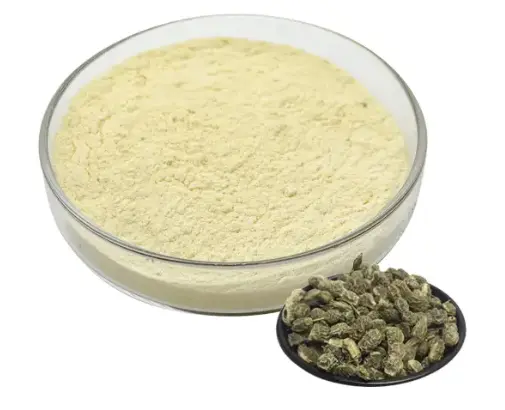
Here's what most buyers don't realize about genistein powder. The molecule itself is chemically identical regardless of source—CAS number 446-72-0, molecular formula C15H10O5, molecular weight 270.24 . But commercial genistein comes from multiple plant sources. Some is extracted from soybean (Glycine max) , some from red clover (Trifolium pratense) , some from Sophora japonica . The extraction process leaves behind trace compounds that vary by source. Those trace compounds don't show up on a standard HPLC purity test. They do show up in your formulation's stability.
Genistein is a phytoestrogen, structurally similar to estradiol-17β, and functions as a highly specific inhibitor of protein tyrosine kinase (PTK) . This mechanism is what makes it valuable for women's health supplements, hormone balance formulations, and research on estrogen-related pathways . The compound itself is well-studied—it's been shown to modulate NF-κB and MAPK signaling, exhibit antioxidant activity, and support bone density . But all that research assumes you're working with consistent material. If your genistein source shifts, your product's performance shifts with it.
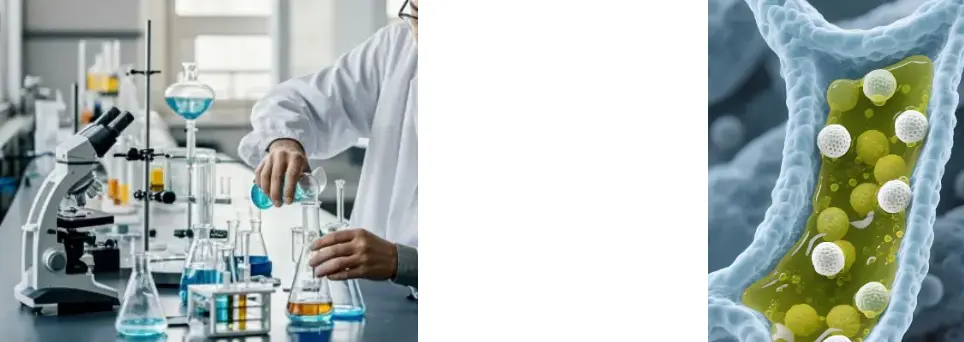
I visited a facility in Shaanxi once where they process genistein from Sophora japonica. The manager walked me through their extraction line—acid hydrolysis, solvent extraction, crystallization, drying. "We can hit 98% every time," he said. I asked about residual flavonoids from the source material. He shrugged. "We don't test for those. Customers only ask for genistein purity." That's fine if you're selling to research labs. Not fine if you're manufacturing a finished supplement that needs to perform the same way batch after batch.
The physical properties matter too. Genistein has a melting point around 297-298°C and is soluble in DMSO, ethanol, and DMF but poorly soluble in water . The crystalline form can vary depending on how it was dried. Some suppliers produce a fine powder that disperses cleanly. Others produce a coarser material that clumps. A quality manager once told me they rejected a batch of genistein powder not because of purity, but because it wouldn't flow through their capsule filling machine. "98% is meaningless if it clogs our equipment," he said.
Storage requirements are another variable. Research-grade genistein is typically stored at -20°C to maintain stability . Commercial material for supplements is often stable at room temperature if properly packaged. But that depends on residual moisture content, packaging, and the specific production process. A supplier who can't tell you their recommended storage conditions probably hasn't tested them.
The market for genistein powder has grown steadily with demand for natural women's health ingredients and plant-based alternatives to hormone therapy . But sourcing has become more complicated as suppliers compete on price. A batch from soybean grown in one region can have a different impurity profile than soybean from another. A batch extracted with different solvents can have different residual solvent levels. These differences don't show up on a standard CoA. They show up when your product fails stability or your customers complain.
A procurement director once told me they now require full isoflavone profiling on every genistein powder batch, not just genistein purity. "We had a batch that was 98% genistein but had elevated daidzein from the source material," he said. "The daidzein didn't affect the spec, but it changed the color of our finished tablets. Customers noticed. We had to rework the whole batch."
If you're sourcing genistein powder, the questions go beyond purity. What's the plant source? What's the residual impurity profile? How was it dried? What's the particle size distribution? What's the stability data at room temperature? Suppliers who can answer these are worth the premium. The ones who can't are selling a number on a CoA, not a predictable ingredient for your formulation.
FAQ
1. What's the actual difference between genistein powder from soybean versus red clover?
The genistein molecule is identical regardless of source. But the trace compounds left behind after extraction differ by source plant. Soybean-derived material may contain residual daidzein or glycitein. Red clover-derived material may contain other isoflavones like formononetin or biochanin A. These trace compounds don't affect the purity spec but can impact stability, color, and solubility. Always ask your supplier about the plant source and request impurity profiling if batch consistency matters for your formulation.
2. What purity should I expect for commercial genistein powder?
Standard commercial genistein is typically ≥98% purity by HPLC . Research-grade material often specifies ≥98% as well, with some suppliers offering >98% . Lower purity grades (around 80-90%) are available for cost-sensitive applications but may contain higher levels of related isoflavones. For most supplement applications, 98% is the industry standard.
3. How should genistein powder be stored for long-term stability?
This depends on the material and packaging. Research-grade genistein for laboratory use is typically stored at -20°C . Commercial grades with low residual moisture and proper packaging (sealed, desiccated, protected from light) can be stable at room temperature for 24 months. Always request stability data from your supplier. The compound degrades faster with exposure to light, heat, and humidity regardless of purity.
4. Is genistein powder soluble in water?
Genistein has poor water solubility. It is soluble in DMSO (up to 100 mM), ethanol (up to 4 mg/mL), DMF (up to 30 mg/mL), and chloroform:methanol mixtures . For aqueous formulations, you'll need to use solubilizers, encapsulation, or consider that the compound is intended for absorption in lipid environments. This is why most genistein supplements use oil-based softgels or liposomal delivery.
5. What certifications should I look for when sourcing genistein powder?
Common certifications include GMP, ISO 22000, Kosher, Halal, and organic depending on target market . For European buyers, traceability to specific growing regions may be required. Request third-party lab verification matching the supplier's in-house purity data. A supplier who can't provide current certificates or won't share batch-specific CoAs is a red flag.
6. What are the main applications for genistein powder in commercial products?
Genistein is used in women's health supplements targeting menopause symptoms, hormone balance formulations, bone health products, and antioxidant blends . It's also used in cosmetic formulations for anti-aging benefits . Research applications include cancer research, estrogen receptor studies, and tyrosine kinase inhibition studies . For dietary supplements, typical dosages range from 25-100 mg per serving depending on the intended benefit and supporting clinical evidence.