- English
- French
- German
- Portuguese
- Spanish
- Russian
- Japanese
- Korean
- Arabic
- Greek
- German
- Turkish
- Italian
- Danish
- Romanian
- Indonesian
- Czech
- Afrikaans
- Swedish
- Polish
- Basque
- Catalan
- Esperanto
- Hindi
- Lao
- Albanian
- Amharic
- Armenian
- Azerbaijani
- Belarusian
- Bengali
- Bosnian
- Bulgarian
- Cebuano
- Chichewa
- Corsican
- Croatian
- Dutch
- Estonian
- Filipino
- Finnish
- Frisian
- Galician
- Georgian
- Gujarati
- Haitian
- Hausa
- Hawaiian
- Hebrew
- Hmong
- Hungarian
- Icelandic
- Igbo
- Javanese
- Kannada
- Kazakh
- Khmer
- Kurdish
- Kyrgyz
- Latin
- Latvian
- Lithuanian
- Luxembou..
- Macedonian
- Malagasy
- Malay
- Malayalam
- Maltese
- Maori
- Marathi
- Mongolian
- Burmese
- Nepali
- Norwegian
- Pashto
- Persian
- Punjabi
- Serbian
- Sesotho
- Sinhala
- Slovak
- Slovenian
- Somali
- Samoan
- Scots Gaelic
- Shona
- Sindhi
- Sundanese
- Swahili
- Tajik
- Tamil
- Telugu
- Thai
- Ukrainian
- Urdu
- Uzbek
- Vietnamese
- Welsh
- Xhosa
- Yiddish
- Yoruba
- Zulu
Why Did Switching Ginger Extract Powder Suppliers Cause a Batch Failure No One Saw Coming?
A supplement manufacturer in New Jersey learned this lesson the hard way. They'd been using the same ginger extract powder for three years in a digestive health formula. Everything worked—stable, consistent, customers happy. Then their supplier raised prices by 20%. They found another source offering the same spec at the old price. CoA showed 5% gingerols, same as before. Heavy metals passed. Microbials clean. First batch of finished product went into production. Within three months, stability testing showed the gingerol content had dropped by 40%. The original material held steady for 18 months. The new one failed in a quarter of the time. The supplier said "it meets spec." They were right. What they didn't say was their material had higher moisture content that accelerated degradation. That number wasn't on the CoA.
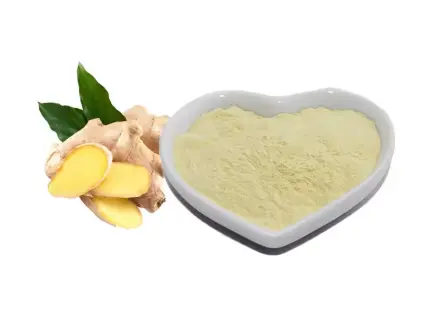
Here's what most buyers don't realize about ginger extract powder. The spec sheet shows total gingerols by HPLC—usually 5%, 10%, or 20% depending on the grade. But gingerols are unstable. They degrade into shogaols over time, especially with heat, moisture, and light . A batch that hits 5% at release can be 3% six months later. The degradation rate depends on residual moisture, processing method, and storage conditions. None of that shows up on the standard CoA. The buyer who only looks at the initial number gets burned when their finished product fails stability.
I was in a facility in Shandong once where they process tons of fresh ginger into extract. The manager showed me their drying setup—spray dryer running at 160°C inlet temperature. "We get good yield," he said. I asked about gingerol retention. He shrugged. "We test at release. It's always 5%. Customers don't ask about stability." That's true for a lot of buyers. They get a CoA with gingerols, heavy metals, microbials, call it good. They don't know that high-heat drying degrades gingerols faster over time. A batch that tests fine today won't stay fine on the shelf.

A product developer once told me they switched to a supplier who provides residual moisture and accelerated stability data on every batch. "We had a batch that passed all the standard tests but failed in our gummies after four months," she said. "The supplier's moisture was 8%. Our reference standard was 4%. They didn't even know because they never tested for it." Now she specifies moisture content ≤4% and requests 40°C stability data before approving any new source.
The extraction method determines more than the initial gingerol number. Supercritical CO₂ extraction preserves the volatile compounds that give ginger its characteristic flavor and activity . Solvent extraction is cheaper but can leave residues and degrade heat-sensitive compounds . Some suppliers use a combination. The cheapest suppliers use the fastest method and don't think about what they're losing. A quality manager once explained their incoming protocol: "We run HPLC for gingerols, test moisture, and check solubility. If it doesn't dissolve cleanly in our base, it doesn't go into production, no matter what the CoA says."
Commercial ginger extract powder comes in grades that look identical on paper. A 5% gingerol extract from one supplier can be CO₂-extracted, low-moisture, designed for stability. The same spec from another can be solvent-extracted, high-moisture, optimized for yield. Same number. Different shelf life. Different performance.
The market for ginger extract powder has grown with demand for natural digestive health and anti-inflammatory supplements . But sourcing has become a race to the bottom on price. The buyers who only look at the initial gingerol number get what they pay for—material that meets the spec today and fails tomorrow.
A procurement director once told me they now require three things on every ginger extract powder batch. "Residual moisture under 4%, accelerated stability data at 40°C for three months, and particle size distribution for our blending line," he said. "The suppliers who can provide that cost more. They also cost less in the long run because we don't have batches failing in the field."
If you're sourcing ginger extract powder, the questions go beyond the gingerol spec. What's the residual moisture? What's the stability data at your expected storage conditions? How was it processed? What's the particle size? Suppliers who can answer these are worth the premium. The ones who can't are selling you a number that won't hold up.

FAQ
1. Why do ginger extract powder batches with the same gingerol content perform differently in stability?
Because gingerols degrade over time. The degradation rate depends on residual moisture, processing method, and storage conditions. A batch with higher moisture or processed at high heat will lose gingerols faster. Standard CoAs don't show degradation rates. Ask for accelerated stability data at 40°C to see how the material holds up.
2. What's the difference between gingerols and shogaols in ginger extract?
Gingerols are the fresh compounds responsible for ginger's characteristic flavor and activity. When ginger is dried or heated, gingerols convert to shogaols, which are less bioactive and have a different flavor profile . A fresh extract high in gingerols will degrade to shogaols over time. A CoA showing high gingerols at release doesn't guarantee they'll stay high.
3. What specifications should I look for when sourcing ginger extract powder for stability-sensitive applications?
Look for gingerol content by HPLC (5%, 10%, 20% typical), residual moisture (≤4% for longer shelf life), particle size consistent with your blending line, and accelerated stability data showing gingerol retention under your expected storage conditions . Request third-party lab verification matching the supplier's in-house data.
4. How should ginger extract powder be stored to maintain potency?
Store in sealed containers away from light, heat, and moisture. Recommended conditions are cool, dry environments below 25°C, ideally under 20°C for long-term storage . Gingerols degrade faster with exposure to heat and humidity. Properly stored, most extracts maintain stability for 24 months. Ask your supplier for specific storage recommendations based on their material.
5. Is ginger extract powder suitable for high-heat applications like baking?
Standard ginger extract powder loses gingerols during high-heat processing. For baked goods or hot-fill applications, look for heat-stabilized grades or consider adding the extract after the heating step. Some suppliers offer encapsulated or stabilized versions designed for thermal processing. Always test stability under your actual production conditions.
6. What certifications should I look for when sourcing ginger extract powder?
Common certifications include GMP, ISO, Kosher, Halal, and organic depending on your target market . Some suppliers offer material compliant with USP or EP standards . For European buyers, traceability to specific growing regions may be required. Request current certificates and verify they cover the facility producing your material.