- English
- French
- German
- Portuguese
- Spanish
- Russian
- Japanese
- Korean
- Arabic
- Greek
- German
- Turkish
- Italian
- Danish
- Romanian
- Indonesian
- Czech
- Afrikaans
- Swedish
- Polish
- Basque
- Catalan
- Esperanto
- Hindi
- Lao
- Albanian
- Amharic
- Armenian
- Azerbaijani
- Belarusian
- Bengali
- Bosnian
- Bulgarian
- Cebuano
- Chichewa
- Corsican
- Croatian
- Dutch
- Estonian
- Filipino
- Finnish
- Frisian
- Galician
- Georgian
- Gujarati
- Haitian
- Hausa
- Hawaiian
- Hebrew
- Hmong
- Hungarian
- Icelandic
- Igbo
- Javanese
- Kannada
- Kazakh
- Khmer
- Kurdish
- Kyrgyz
- Latin
- Latvian
- Lithuanian
- Luxembou..
- Macedonian
- Malagasy
- Malay
- Malayalam
- Maltese
- Maori
- Marathi
- Mongolian
- Burmese
- Nepali
- Norwegian
- Pashto
- Persian
- Punjabi
- Serbian
- Sesotho
- Sinhala
- Slovak
- Slovenian
- Somali
- Samoan
- Scots Gaelic
- Shona
- Sindhi
- Sundanese
- Swahili
- Tajik
- Tamil
- Telugu
- Thai
- Ukrainian
- Urdu
- Uzbek
- Vietnamese
- Welsh
- Xhosa
- Yiddish
- Yoruba
- Zulu
What Does the Color of Rosehip Fruit Extract Actually Tell You About Its Quality?
A supplement manufacturer in Oregon called me last year with a problem that sounds simple but cuts to the heart of botanical sourcing. They'd been using rosehip fruit extract in a vitamin C formulation for years, sourcing from the same supplier, everything consistent. Then they received a batch that was noticeably darker than usual—more brown than orange-red. The supplier assured them it was fine. "It's just natural variation," they said. The manufacturer ran their own tests anyway. The vitamin C content had dropped by 40%. The powder still met the spec sheet's minimum requirements. But the product they were making no longer met its label claim.
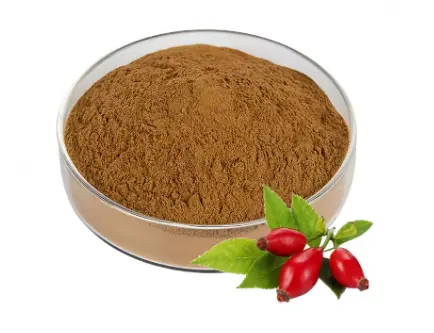
Here's the thing about rosehip fruit extract that most buyers don't realize until it bites them. The rose hip—the fruit left behind after the rose flower falls—is packed with vitamin C, flavonoids, and carotenoids . But those compounds degrade at different rates depending on how the fruit was harvested, how long it sat before processing, and what temperature it saw during drying. The color of the powder is a proxy for how much of that fragile chemistry survived. Bright orange-red means the carotenoids are intact. Brown means they oxidized. And when the carotenoids go, the vitamin C usually goes with them.
The fruit comes from wild rose species, primarily Rosa canina in Europe and Rosa rugosa in Asia . Commercial production centers in Chile, Bulgaria, and parts of China . The wild-harvested material from Chile and Eastern Europe commands premium pricing because it's picked at peak ripeness and processed quickly . Mass-produced material from cultivated sources often sacrifices quality for volume. If your supplier can't tell you where their hips came from and when they were harvested, they can't guarantee the degradation hasn't started before processing.

I watched a production line in Shandong once where they ran rose hips through a standard hot-air dryer at 70°C. The manager was proud of their throughput—tons per day. I asked about vitamin C retention. He shrugged. "We don't test that. The spec is 1% vitamin C minimum. We always hit that." What he didn't say was that their material might hit 1% at release and drop to 0.5% by the time it reached a customer. Low-temperature drying preserves the ascorbic acid and the delicate volatile compounds. High-temperature drying is faster and cheaper. The price difference reflects that choice.
Commercial specifications for quality rosehip fruit extract follow established parameters. Vitamin C content typically runs 2-5% by HPLC, with carotenoids measured as beta-carotene equivalents . Loss on drying should be ≤5%, total ash ≤5%, and particle size 100% through 80 mesh for consistent blending . Heavy metals: lead ≤3ppm, arsenic ≤2ppm, cadmium ≤1ppm, mercury ≤0.1ppm . Microbial specs: total plate count ≤1000 CFU/g, yeast and mold ≤100 CFU/g, pathogens absent . But here's the catch—those specs only capture the starting point. They don't tell you how fast the vitamin C will degrade in your warehouse.
A quality director once showed me their incoming test for rosehip fruit extract. They don't just run HPLC for vitamin C. They put a sample in a humidity chamber at 40°C and 75% RH for two weeks, then retest. "If it drops more than 10%," he said, "we don't care how good the initial numbers look. It won't survive our supply chain." That kind of testing separates serious buyers from price shoppers.
The market for rosehip fruit extract has grown steadily, driven by demand for natural vitamin C sources and skin health supplements . Formulators use it in capsules, tablets, powdered beverages, and increasingly in cosmetics for its antioxidant and collagen-supporting properties . But the applications demand different stability profiles. What works in a sealed capsule with a desiccant might not work in a powdered drink mix exposed to humidity during manufacturing.
A product developer told me they switched from rosehip fruit extract to ascorbic acid after repeated stability failures. "We couldn't control the raw material variability," she said. "One batch would hold potency for 18 months. The next would drop below label claim in 6. The supplier couldn't explain why." That's the risk of sourcing from suppliers who don't control their own supply chain.
The wild-harvested material tells a different story. The Chilean rose hips come from plants that grow in the Andes foothills, picked at peak ripeness in autumn, dried within days using solar or low-temperature methods . The Bulgarian material follows similar traditions. The powder comes out bright orange-red, smells like dried fruit, and holds its potency. It costs more. It's worth it for anyone whose product depends on consistent performance.
A contract manufacturer once told me they stopped accepting rosehip fruit extract from spot suppliers entirely. "We had a batch that looked fine at release, failed six months later, and cost us a major retail account," the QC manager said. "Now we only buy from suppliers who can show us 12 months of stability data on their own material. If they don't have it, they don't get the business."
FAQ
1. What's the difference between rosehip fruit extract and rosehip powder?
Rosehip powder is typically made by drying and milling the whole fruit, including seeds and hairs, which contain some vitamin C but also fiber . Rosehip fruit extract is a concentrated product made by solvent extraction, yielding higher potency of vitamin C and flavonoids per gram . Extract is more expensive but allows smaller dosage forms. Powder is cheaper but requires larger capsules or tablets to deliver the same active levels.
2. Why does rosehip fruit extract color vary so much between suppliers?
Color variation reflects processing temperature and raw material freshness. Bright orange-red indicates the carotenoids survived low-temperature drying and fresh fruit . Brown or dull powder suggests high heat during drying or old fruit that oxidized before processing . The same color change that ruins the visual appeal usually correlates with lower vitamin C content. Always request samples from multiple batches before placing large orders.
3. What specifications should I look for when sourcing rosehip fruit extract?
Key specs include vitamin C content (typically 2-5% by HPLC), loss on drying (≤5%), heavy metals within limits, and microbial compliance . For products making stability claims, request accelerated stability data showing how potency holds up under your expected storage conditions . Third-party lab verification matching the supplier's in-house data provides essential assurance.
4. How should rosehip fruit extract be stored to maintain vitamin C potency?
Store in sealed containers away from moisture, light, and heat. Recommended conditions are cool, dry environments below 25°C . The powder is hygroscopic—exposure to humidity accelerates degradation of both vitamin C and color . For long-term storage, consider nitrogen-flushed packaging or adding desiccants. Always check the manufacturer's expiration date and request stability data for your intended supply chain conditions.
5. Is rosehip fruit extract suitable for hot-process applications?
Rosehip is relatively heat-sensitive—vitamin C begins degrading above 60°C . For hot-process applications like baking or hot-fill beverages, consider adding after the heating step or using encapsulated forms that protect the actives. Some suppliers offer heat-stabilized grades specifically for challenging applications. Always test stability under your actual processing conditions.
6. What certifications should I look for when sourcing rosehip fruit extract?
Common certifications include organic (USDA, EU), kosher, halal, and non-GMO depending on your target market . For European buyers, wild-harvested documentation may be required to verify sustainable sourcing . GMP certification ensures consistent quality systems. Request current certificates and verify they cover the specific facility producing your material.