- English
- French
- German
- Portuguese
- Spanish
- Russian
- Japanese
- Korean
- Arabic
- Greek
- German
- Turkish
- Italian
- Danish
- Romanian
- Indonesian
- Czech
- Afrikaans
- Swedish
- Polish
- Basque
- Catalan
- Esperanto
- Hindi
- Lao
- Albanian
- Amharic
- Armenian
- Azerbaijani
- Belarusian
- Bengali
- Bosnian
- Bulgarian
- Cebuano
- Chichewa
- Corsican
- Croatian
- Dutch
- Estonian
- Filipino
- Finnish
- Frisian
- Galician
- Georgian
- Gujarati
- Haitian
- Hausa
- Hawaiian
- Hebrew
- Hmong
- Hungarian
- Icelandic
- Igbo
- Javanese
- Kannada
- Kazakh
- Khmer
- Kurdish
- Kyrgyz
- Latin
- Latvian
- Lithuanian
- Luxembou..
- Macedonian
- Malagasy
- Malay
- Malayalam
- Maltese
- Maori
- Marathi
- Mongolian
- Burmese
- Nepali
- Norwegian
- Pashto
- Persian
- Punjabi
- Serbian
- Sesotho
- Sinhala
- Slovak
- Slovenian
- Somali
- Samoan
- Scots Gaelic
- Shona
- Sindhi
- Sundanese
- Swahili
- Tajik
- Tamil
- Telugu
- Thai
- Ukrainian
- Urdu
- Uzbek
- Vietnamese
- Welsh
- Xhosa
- Yiddish
- Yoruba
- Zulu
How Do You Know If Your Rosemary Leaf Extract Has the Right Diterpene Profile?
The original rosemary leaf extract worked fine—20% total phenolics, consistent results. The new supplier offered the same spec at 15% lower cost. First batch passed all the standard tests. But when the finished product hit stability, the antioxidant numbers dropped faster than expected. Their lab ran a full HPLC on the incoming powder. Rosmarinic acid was spot on. Carnosic acid had dropped from 8% to 3%. The supplier had optimized their extraction for rosmarinic acid yield, not the diterpene profile that mattered for their application. Same spec on paper. Wrong material for the job.
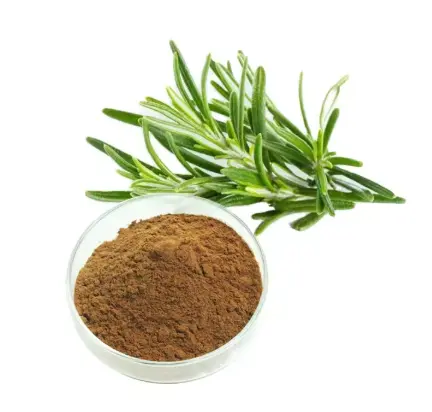
Here's the reality most buyers discover too late. Rosemary leaf extract contains three main active groups: rosmarinic acid (water-soluble, strong antioxidant), carnosic acid (lipophilic, crosses the blood-brain barrier), and carnosol (related diterpene with its own activity) . Different extraction methods pull different ratios. Ethanol extraction favors rosmarinic acid. CO₂ extraction preserves diterpenes better. Some processors optimize for total phenolic yield because that's what most spec sheets require. The total number can stay the same while the functional profile shifts. If your supplier doesn't test for individual diterpenes, they don't know what they're shipping.
The plant Rosmarinus officinalis grows wild across the Mediterranean and is now cultivated heavily in China, Spain, and Morocco . Chinese production dominates the standardized extract market, with major facilities in Shaanxi, Hunan, and Sichuan . Growing conditions affect baseline chemistry—rosmarinic acid varies with soil, climate, and harvest timing . A supplier buying raw material from multiple regions without tracking origin can't guarantee diterpene consistency. They can guarantee price. Those aren't the same thing.

I watched a facility in Shaanxi run rosemary through a high-temperature ethanol extraction optimized for yield. The manager showed me their CoA: 20% total phenolics, rosmarinic acid by HPLC, heavy metals, microbials. I asked about carnosic acid. He shrugged. "Nobody asks," he said. "They just want the total number." That works for some buyers—food preservation, general antioxidant blends. But for cognitive health supplements, the diterpene content matters. Carnosic acid has documented neuroprotective effects that rosmarinic acid doesn't share . If you're formulating for brain health and your supplier doesn't track diterpenes, you're guessing.
Commercial specs typically list total phenolics (10-30% by Folin-Ciocalteu), rosmarinic acid (2-5% by HPLC), loss on drying ≤5%, total ash ≤5%, heavy metals within limits, particle size 100% through 80 mesh . These numbers don't tell you the diterpene-to-phenolic ratio. A 20% total phenolic extract could be 18% rosmarinic acid with 2% diterpenes, or 8% rosmarinic acid with 12% diterpenes. Same spec. Different applications. Different pricing.
A product developer once told me they now specify both rosmarinic acid and carnosic acid content on every purchase order. "We had a batch that passed all the standard tests but failed our stability study," she said. "When we dug into it, the carnosic had dropped by half. The supplier didn't even know because they never tested for it. Now we test every batch ourselves."

The application determines which profile matters. For food preservation, total antioxidant activity is sufficient—any combination works . For dietary supplements targeting brain health, carnosic acid content matters more . For skincare, rosmarinic acid's anti-inflammatory properties drive efficacy . A supplier who asks about your application before sending samples understands the difference. One who sends the same material to everyone treats it as a commodity.
A quality director once explained their incoming test for rosemary leaf extract. They run a full HPLC fingerprint and overlay every batch against their reference standard. "If the peak ratios don't match," he said, "we reject it. The total phenolic number can be perfect, but if the fingerprint shifted, the material changed. We learned that after a batch failure cost us a major account."
The market keeps growing—clean-label preservation, cognitive supplements, natural cosmetics all driving demand . But the gap between commodity material and functional material is widening. Suppliers who can provide full HPLC fingerprinting and individual diterpene quantification capture premium contracts. Suppliers who optimize for total phenolics compete on price alone. Mix them up and you're the one who pays.
FAQ
1. What's the difference between rosmarinic acid and carnosic acid in rosemary leaf extract?
Rosmarinic acid is a water-soluble phenolic with strong antioxidant and anti-inflammatory properties, stable in aqueous formulations . Carnosic acid is a lipophilic diterpene that also acts as a powerful antioxidant but has better stability in oil-based systems and may have different bioavailability and brain penetration . Both are valuable, but the right ratio depends entirely on your application.
2. What specifications should I look for when sourcing rosemary leaf extract for cognitive health formulations?
Beyond total phenolics (typically 10-20%), request individual quantification of rosmarinic acid, carnosic acid, and carnosol by HPLC . For brain health applications, prioritize extracts with documented diterpene content . Ask for heavy metals, microbial specs, and loss on drying. Request third-party lab verification matching supplier's in-house data. A supplier who can't provide individual diterpene numbers doesn't know what they're selling.
3. Why does the antioxidant activity of rosemary leaf extract vary even with the same total phenolic content?
Different compounds contribute differently to antioxidant activity. Rosmarinic acid, carnosic acid, and carnosol have different potencies and mechanisms . An extract high in rosmarinic acid but low in diterpenes will have different ORAC values than one with a balanced profile, even with the same total phenolic number. Request activity testing if antioxidant performance matters for your formulation.
4. How should rosemary leaf extract be stored to maintain diterpene potency?
Store in sealed containers away from light, heat, and moisture. Recommended conditions are cool, dry environments below 25°C . Carnosic acid is particularly sensitive to oxidation—exposure to air degrades it over time. Nitrogen-flushed packaging extends shelf life for diterpene-rich extracts. Properly stored, most powders maintain stability for 24 months.
5. Is rosemary leaf extract suitable for oil-based formulations?
Yes, but choose the right grade. Rosmarinic acid is water-soluble and may not disperse well in oils . Carnosic acid and carnosol are lipophilic and perform better in oil-based systems like softgels, lipid-based supplements, and cosmetic emulsions . For these applications, look for extracts standardized to diterpene content or oil-soluble grades designed for your use.
6. What certifications should I look for when sourcing rosemary leaf extract?
Common certifications include organic (USDA, EU), kosher, halal, and non-GMO depending on target market . For European buyers, traceability to specific growing regions may be required. GMP certification ensures consistent quality systems. Request current certificates and verify they cover the facility producing your material.