- English
- French
- German
- Portuguese
- Spanish
- Russian
- Japanese
- Korean
- Arabic
- Greek
- German
- Turkish
- Italian
- Danish
- Romanian
- Indonesian
- Czech
- Afrikaans
- Swedish
- Polish
- Basque
- Catalan
- Esperanto
- Hindi
- Lao
- Albanian
- Amharic
- Armenian
- Azerbaijani
- Belarusian
- Bengali
- Bosnian
- Bulgarian
- Cebuano
- Chichewa
- Corsican
- Croatian
- Dutch
- Estonian
- Filipino
- Finnish
- Frisian
- Galician
- Georgian
- Gujarati
- Haitian
- Hausa
- Hawaiian
- Hebrew
- Hmong
- Hungarian
- Icelandic
- Igbo
- Javanese
- Kannada
- Kazakh
- Khmer
- Kurdish
- Kyrgyz
- Latin
- Latvian
- Lithuanian
- Luxembou..
- Macedonian
- Malagasy
- Malay
- Malayalam
- Maltese
- Maori
- Marathi
- Mongolian
- Burmese
- Nepali
- Norwegian
- Pashto
- Persian
- Punjabi
- Serbian
- Sesotho
- Sinhala
- Slovak
- Slovenian
- Somali
- Samoan
- Scots Gaelic
- Shona
- Sindhi
- Sundanese
- Swahili
- Tajik
- Tamil
- Telugu
- Thai
- Ukrainian
- Urdu
- Uzbek
- Vietnamese
- Welsh
- Xhosa
- Yiddish
- Yoruba
- Zulu
Can Your Garcinia Cambogia Extract Powder Supplier Deliver Real Batch-to-Batch Consistency?
A few years back, a buyer from a European supplement company called me with a problem. They'd launched a weight management product using garcinia cambogia extract powder from three different suppliers over eighteen months. Each batch looked fine on paper—50% HCA, clean CoAs. But their customers noticed. The first batch worked well, the second did nothing, and the third caused some digestive complaints. They lost a whole retail account over it. That's when I learned something about this ingredient: the HCA number on the certificate is only half the story.
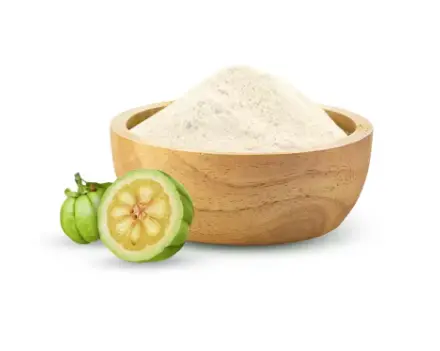
The active compound in it is hydroxycitric acid (HCA), typically standardized to 50% or 60% for commercial use . The fruit rind itself contains HCA at about 30% by weight, so getting to 50% or 60% requires concentration through extraction . Indonesia and Thailand are the primary growing regions, supplying most of the raw material globally . That's where the supply chain gets tricky—manufacturers in China and India import the fruit, process it, and ship extracts worldwide . Each transfer adds variability risk.
What I've learned after years of handling this ingredient: the best garcinia cambogia extract powder comes from suppliers who control both ends of the chain. They have relationships with farmers in Southeast Asia, know when the fruit was harvested, and process it quickly. The alternative—buying spot material from traders—means you get whatever batch is available, with no history and no predictability. For a B2B buyer placing garcinia cambogia extract powder bulk orders, that's a gamble you don't want to take.
The global market for this extract reached about $183 million in 2026, with North America accounting for roughly 35% of consumption . That's a lot of capsules and powders moving through retail. But what the market reports don't tell you is that over 45% of supplement formulations containing garcinia rely on it as a primary active ingredient . If your batch is off, your whole product fails. This is why we test every production lot for HCA concentration, heavy metals, and microbial limits before it leaves our facility.

A procurement manager asked me recently how to spot a reliable supplier. I told him to start with the CoA, but don't stop there. Look for third-party lab verification matching the in-house numbers. Ask about the extraction method—ethanol and water are standard, but residual solvent specs should be tight . Request sieve analysis to confirm particle size; 100% through 40 mesh is typical . And get samples from three different batches before committing to volume. If the color or solubility varies, the supplier can't control their process.
The regulatory landscape is shifting too. Europe's EFSA remains cautious on weight-loss claims, which means documentation matters more than ever . US buyers should verify that their it meets GRAS standards for dietary supplements. We maintain full traceability on every batch—from the farm in Indonesia or India to the finished powder in our warehouse—so our customers have the paperwork they need for any market.

If you're sourcing garcinia cambogia extract powder for your formulations, the choice comes down to predictability. A supplier who can show you twelve months of consistent batch data, who visits their raw material sources, and who tests for everything from arsenic to salmonella—that's a partner worth building with. The rest are just selling powder with a number on it.
IF You Are Interested In The Products We Operate And Other Related Categories, Please Write To Us And Contact Us. At The Same Time, You Can Also Browse Our Website To Find The Products You Want. We Provide Customized Services And Look Forward To Establishing Cooperation With You.
Email:sales@greenherbbt.com