- English
- French
- German
- Portuguese
- Spanish
- Russian
- Japanese
- Korean
- Arabic
- Greek
- German
- Turkish
- Italian
- Danish
- Romanian
- Indonesian
- Czech
- Afrikaans
- Swedish
- Polish
- Basque
- Catalan
- Esperanto
- Hindi
- Lao
- Albanian
- Amharic
- Armenian
- Azerbaijani
- Belarusian
- Bengali
- Bosnian
- Bulgarian
- Cebuano
- Chichewa
- Corsican
- Croatian
- Dutch
- Estonian
- Filipino
- Finnish
- Frisian
- Galician
- Georgian
- Gujarati
- Haitian
- Hausa
- Hawaiian
- Hebrew
- Hmong
- Hungarian
- Icelandic
- Igbo
- Javanese
- Kannada
- Kazakh
- Khmer
- Kurdish
- Kyrgyz
- Latin
- Latvian
- Lithuanian
- Luxembou..
- Macedonian
- Malagasy
- Malay
- Malayalam
- Maltese
- Maori
- Marathi
- Mongolian
- Burmese
- Nepali
- Norwegian
- Pashto
- Persian
- Punjabi
- Serbian
- Sesotho
- Sinhala
- Slovak
- Slovenian
- Somali
- Samoan
- Scots Gaelic
- Shona
- Sindhi
- Sundanese
- Swahili
- Tajik
- Tamil
- Telugu
- Thai
- Ukrainian
- Urdu
- Uzbek
- Vietnamese
- Welsh
- Xhosa
- Yiddish
- Yoruba
- Zulu
Can Your Coleus Forskohlii Extract Supplier Deliver Consistent Forskolin Content Batch After Batch?
Got a call last month from a procurement manager I've worked with for years. His company had been sourcing Coleus Forskohlii Extract for a metabolic support formulation, and everything was running smoothly until the fourth batch arrived. Same spec on paper—20% forskolin—but the powder looked darker, the solubility was different, and when they ran their own HPLC, the active compound came back at 14%. The supplier said "seasonal variation." What they meant was they didn't control their raw material sourcing. This is the reality of buying botanical extracts: the number on the Certificate of Analysis means nothing if the supplier can't guarantee it batch after batch.
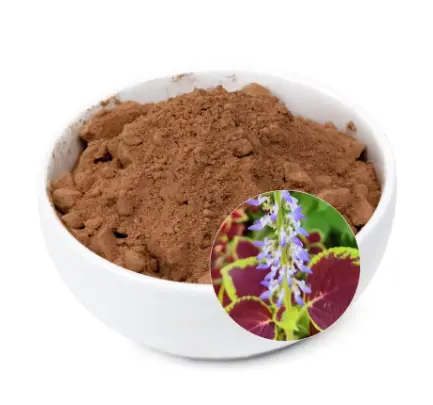
Coleus forskohlii is a perennial plant in the mint family (Lamiaceae), native to India and other subtropical regions including Nepal, Thailand, and Sri Lanka . It's also cultivated in parts of China, particularly in Yunnan, Guizhou, Guangxi, Guangdong, Fujian, and Taiwan . The plant grows up to 60 centimeters tall with tuber-like roots that contain the active compound—a diterpene called forskolin . Unlike many botanical extracts where the active compound is just one of many constituents, Coleus Forskohlii Extract is valued specifically for its forskolin content, which is unique to this plant .
The roots are harvested, dried, and processed using solvent extraction methods to isolate and concentrate the forskolin . Commercial extracts are typically standardized to forskolin content ranging from 10% up to 98%, with 10%, 20%, and 40% being the most common specifications for dietary supplements . The extraction process must be carefully controlled—high temperatures or harsh solvents can degrade the delicate forskolin molecule. Advanced manufacturers use gentle extraction conditions and run HPLC analysis on every batch to verify potency .

Forskolin works through a well-understood mechanism: it activates the enzyme adenylate cyclase, which increases levels of cyclic AMP (cAMP) in cells . This signaling molecule affects numerous physiological processes. In smooth muscle tissue, including heart and bronchial muscle, increased cAMP leads to relaxation and improved circulation . This mechanism explains the traditional uses of Coleus Forskohlii Extract in Ayurvedic medicine for heart conditions and respiratory support .
In the dietary supplement market, Coleus Forskohlii Extract is primarily positioned for weight management and metabolic support formulations . The theory is that increased cAMP levels may influence lipid metabolism and support healthy body composition . It's often combined with other ingredients like green tea extract, dietary fiber, or B vitamins in products targeting consumers interested in body weight management . The application forms vary widely—capsules, tablets, powdered beverage mixes, and even functional foods .

Research has also explored other potential applications. Studies in rabbits showed that topical application of forskolin reduced intraocular pressure, which is relevant to glaucoma management . Some research has investigated its effects on blood pressure regulation and inhibition of platelet aggregation . Animal studies have suggested it may improve insulin utilization, indicating potential relevance for blood sugar management . It's also been shown to stimulate thyroid hormone secretion in some studies . However, it's important to note that much of this research is preclinical, and the supplement market primarily focuses on the weight management and metabolic support applications.
The technical specifications for commercial Coleus Forskohlii Extract are well-established. A proper Certificate of Analysis should include assay for forskolin by HPLC, typically showing 10% to 40% depending on the grade . Physical parameters include loss on drying ≤5%, particle size with minimum 95% through 40 mesh, tapped density minimum 0.40 g/ml, and pH of 1% solution between 4.0 and 7.0 . The powder is insoluble in water and insoluble in 50% alcohol . Color can range from brown to dark brown powder with characteristic odor and taste, and slight variation can occur due to different geographical sources and seasonal variations in plant materials .
Heavy metal limits are strictly controlled in quality material: arsenic ≤1 ppm, cadmium ≤1 ppm, lead ≤3 ppm, mercury ≤0.1 ppm . Microbial specifications include total plate count ≤5000 CFU/g, yeast and mold ≤100 CFU/g, and pathogens including E. coli, Salmonella, P. aeruginosa, and S. aureus must be absent . Residual solvents should comply with USP standards .

Shelf life is typically three years when stored properly—away from moisture, freezing, and temperatures above 30°C . Packaging is usually in food-grade HDPE bags sealed into HDPE containers or fiber drums with double polyethylene liners .
When evaluating suppliers, a few things matter most. First, ask for batch-specific HPLC data showing actual forskolin content, not just a pass/fail statement. Second, request heavy metal and microbial test results for every batch. Third, inquire about raw material traceability—can they tell you where the roots were grown and when they were harvested? Fourth, confirm manufacturing certifications like GMP, ISO, Halal, or Kosher as applicable to your market . Suppliers who can provide third-party lab verification matching their in-house data are worth prioritizing.
A procurement director once told me something that stuck. He said "I don't need the lowest price. I need every batch to match the first one, and I need the paperwork to prove it when my quality team asks." That's exactly what matters with Coleus Forskohlii Extract—consistent forskolin content, reliable solubility, and documentation that holds up to audit.
FAQ
1. What is forskolin and why is it the key compound in Coleus Forskohlii Extract?
Forskolin is a diterpene compound found uniquely in the roots of Coleus forskohlii . It's the primary active constituent that drives the biological activity of the extract. Forskolin works by activating the enzyme adenylate cyclase, which increases levels of cyclic AMP (cAMP) inside cells . This signaling molecule affects numerous physiological processes including smooth muscle relaxation, lipid metabolism, and hormone secretion. Commercial extracts are standardized based on their forskolin content, typically ranging from 10% to 40% for supplements and up to 98% for research or pharmaceutical applications .
2. What are the main applications of Coleus Forskohlii Extract in dietary supplements?
The primary supplement application is weight management and metabolic support . The extract is included in formulations targeting body composition, often combined with other ingredients like green tea extract, fiber, or B vitamins . It's also used in products supporting cardiovascular health and blood pressure management, based on its traditional use and mechanism of action . Some formulations target respiratory support, given its historical use for asthma and bronchial conditions . The extract appears in capsules, tablets, powdered beverages, and functional foods .
3. What specifications should I look for when sourcing Coleus Forskohlii Extract?
Key specifications include forskolin content verified by HPLC (typically 10%, 20%, or 40%), loss on drying ≤5%, heavy metals within limits (lead ≤3ppm, arsenic ≤1ppm), and microbial compliance (total plate count ≤5000 CFU/g, pathogens absent) . The powder should be brown to dark brown with characteristic odor, insoluble in water . Particle size should be consistent for your application, typically 95% through 40 mesh . Certifications like GMP, Halal, Kosher, or organic may be required depending on your target market .
4. How should Coleus Forskohlii Extract be stored to maintain potency?
Store in sealed containers away from direct light, heat, and moisture. Recommended conditions are temperatures below 30°C with relative humidity controlled . Properly stored, most extracts maintain stability for three years from the manufacturing date . Always check the manufacturer's expiration date and follow storage guidelines on the Certificate of Analysis.
5. Are there any safety considerations with Coleus Forskohlii Extract?
Coleus is generally well-tolerated, but it should be avoided in people with ulcers as it may increase stomach acid levels . The safety during pregnancy and breastfeeding hasn't been established . As with any botanical extract, users should consult healthcare providers for specific medical conditions. The extract is intended for use in dietary supplements and functional foods, not as a pharmaceutical treatment for disease .
6. What's the difference between various forskolin percentages in Coleus Forskohlii Extract?
Higher percentages mean more concentrated forskolin content. A 10% extract contains 100 mg of forskolin per gram of powder, while a 40% extract contains 400 mg per gram. The choice depends on your application—lower percentages (10-20%) are common for general dietary supplements where cost-effectiveness matters . Higher percentages (40% and above) are used when you need to deliver more forskolin in a smaller dosage form, such as in capsules where space is limited, or for research applications requiring high purity . The extraction process to achieve higher purity is more complex and results in higher cost per gram.