- English
- French
- German
- Portuguese
- Spanish
- Russian
- Japanese
- Korean
- Arabic
- Greek
- German
- Turkish
- Italian
- Danish
- Romanian
- Indonesian
- Czech
- Afrikaans
- Swedish
- Polish
- Basque
- Catalan
- Esperanto
- Hindi
- Lao
- Albanian
- Amharic
- Armenian
- Azerbaijani
- Belarusian
- Bengali
- Bosnian
- Bulgarian
- Cebuano
- Chichewa
- Corsican
- Croatian
- Dutch
- Estonian
- Filipino
- Finnish
- Frisian
- Galician
- Georgian
- Gujarati
- Haitian
- Hausa
- Hawaiian
- Hebrew
- Hmong
- Hungarian
- Icelandic
- Igbo
- Javanese
- Kannada
- Kazakh
- Khmer
- Kurdish
- Kyrgyz
- Latin
- Latvian
- Lithuanian
- Luxembou..
- Macedonian
- Malagasy
- Malay
- Malayalam
- Maltese
- Maori
- Marathi
- Mongolian
- Burmese
- Nepali
- Norwegian
- Pashto
- Persian
- Punjabi
- Serbian
- Sesotho
- Sinhala
- Slovak
- Slovenian
- Somali
- Samoan
- Scots Gaelic
- Shona
- Sindhi
- Sundanese
- Swahili
- Tajik
- Tamil
- Telugu
- Thai
- Ukrainian
- Urdu
- Uzbek
- Vietnamese
- Welsh
- Xhosa
- Yiddish
- Yoruba
- Zulu
Why Two Bottles Labeled Garlic Extract Powder Can Have Completely Different Effects?
A buyer in Germany learned this the hard way. His company sourced garlic extract powder from a Chinese supplier for three years, same spec, same price, everything consistent. Then they switched to a different vendor offering 15% lower cost. First batch tested fine—alliin numbers matched. But when they ran stability studies, the new material degraded twice as fast. By month nine, activity was half what it should be. The supplier said "store it colder." What they meant was their drying process had damaged the material.
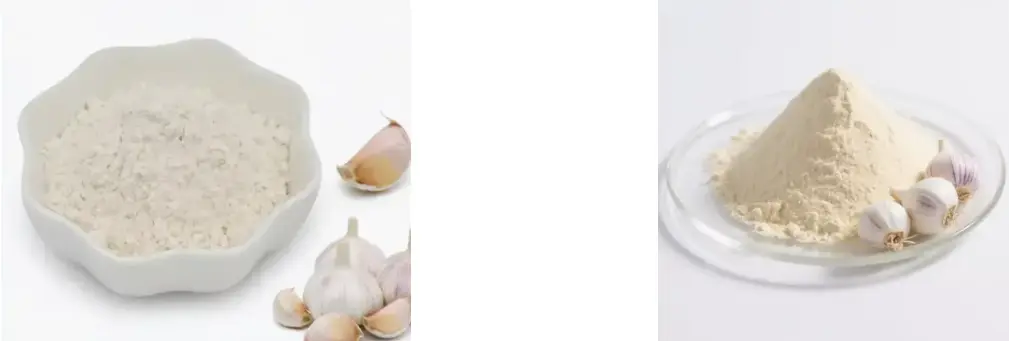
Fresh garlic cloves contain about 1% alliin by weight. The enzyme alliinase sits in separate compartments, waiting. When you crush garlic, they mix, and alliin converts to allicin within seconds. Allicin gives garlic its smell and most of its health benefits. It's also unstable—degrades at room temperature, disappears with heat, and barely survives processing. That's the fundamental tension in garlic extract powder. You can stabilize it for shelf life and lose activity, or preserve activity and accept shorter shelf life.
Most commercial production opts for stability over function. High-temperature spray drying kills alliinase completely. What's left is alliin without the enzyme to convert it—like a gun without a trigger. The spec sheet shows alliin content, so technically it meets the spec. But it won't produce allicin in your body. The CoA tells the truth without telling the whole truth.

A lab technician once showed me their incoming test for garlic extract powder. They don't just run HPLC. They put a gram in a beaker, add water, wait ten minutes, and smell it. "If it doesn't smell like fresh-cut garlic," he said, "I don't care what the numbers say. It's rejected." That simple test catches what labs miss.
The clinical evidence for garlic—cardiovascular support, immune function, antioxidant activity—comes from studies using material with verified activity . If your extract lacks that activity, you're selling powder that meets the spec but won't deliver the effect customers expect. They'll notice eventually, and they won't blame the supplier. They'll blame you.
FAQ
1. What actually happens in garlic extract powder during processing?
Fresh garlic contains alliin and alliinase in separate compartments. When crushed, they mix and produce allicin. Commercial processing usually involves drying and grinding, which can destroy alliinase. Without active alliinase, allicin won't form when you consume the powder. The powder may still taste slightly garlicky but won't have the same biological activity.
2. Why don't standard lab tests catch inactive garlic extract powder?
Standard tests measure alliin content, not alliinase activity. A powder can have plenty of alliin but zero active enzyme. It passes the chemical spec but fails the functional test. Request alliinase activity data or do a simple hydration test—add water and check for fresh garlic odor within 10-15 minutes.
3. Can garlic extract powder with preserved enzyme activity have reasonable shelf life?
Yes, but it's shorter than heat-treated material—typically 12-24 months under ideal storage (cool, dry, sealed, protected from light). Higher temperatures accelerate enzyme degradation. If you need longer shelf life, consider alternative delivery forms like oil-based extracts or aged garlic products with different active compounds.
4. What's the actual difference between culinary garlic extract powder and supplement-grade material?
Culinary powder can be heat-treated for stability and cost. It adds flavor but won't produce allicin. Supplement-grade material preserves enzyme activity, costs more, and has shorter shelf life. Your application determines which you need. For health benefits, you need functional material. For soup mixes, culinary grade works fine.
5. Are there alternatives to enzyme-active garlic extract powder for supplements?
Yes. Garlic oils, aged garlic extracts, and extracts standardized to specific sulfur compounds like S-allyl cysteine don't rely on allicin formation. They're more stable and have their own clinical data. Choose based on your target application and the evidence you want to reference.
6. What questions should I ask suppliers before buying garlic extract powder?
Ask for alliin content and alliinase activity data. Ask about processing temperatures and drying methods. Request third-party lab verification matching their in-house numbers. Ask for stability data under recommended storage. And do your own smell test on samples. If it doesn't smell like fresh garlic when hydrated, it won't work.