




Blog
Is the Lycopene Powder You Are Sourcing Actually the Right Type for Your Product?

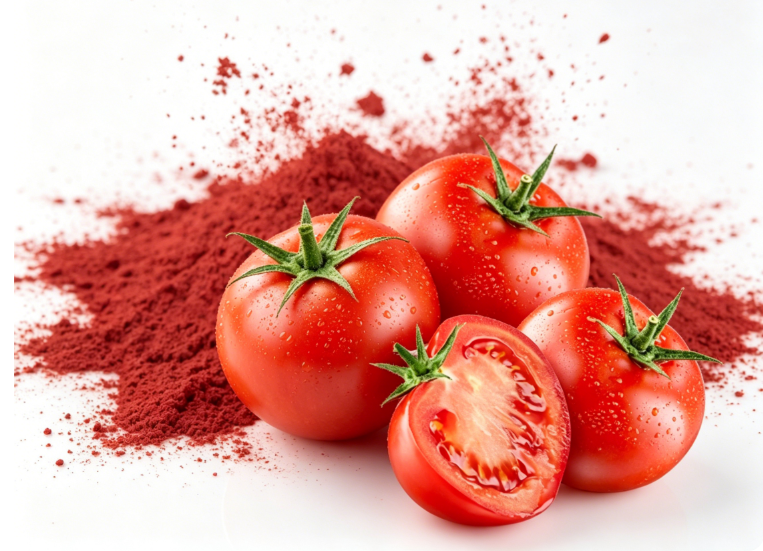
Lycopene powder looks simple on the surface — red pigment, antioxidant, comes from tomatoes. Until you start comparing supplier quotes and realize the same ingredient has three completely different production origins, wildly different price points, and regulatory status that varies by market. Picking based on price alone is a reliable way to create problems downstream.
Here is what actually separates one type from another.

Natural, synthetic, and fermentation — three different products
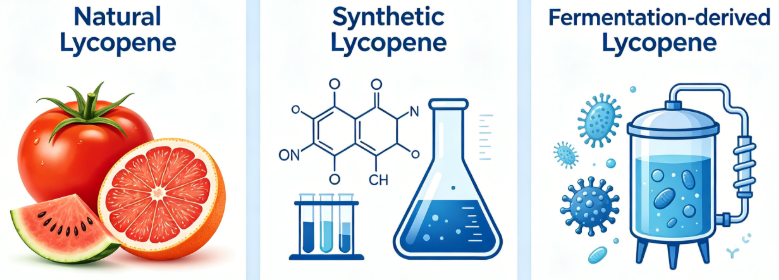
Natural lycopene powder is extracted from tomatoes or other lycopene-rich fruits like watermelon and pink grapefruit. Tomatoes are by far the dominant commercial source. The extraction process typically uses hexane or supercritical CO2 — the latter is increasingly preferred by clean-label buyers because it leaves no solvent residue. Natural tomato lycopene powder carries clean-label positioning and is what most consumer-facing supplement and food brands want on their ingredient lists. It leads the market with roughly 59% share by revenue as of 2024.
Synthetic lycopene is chemically identical to the natural compound at the molecular level but is produced through chemical synthesis rather than plant extraction. It is significantly cheaper and offers more consistent purity and batch uniformity. For large-scale food fortification and pharmaceutical applications where cost matters more than label claims, synthetic is a legitimate option. The challenge is regulatory — synthetic lycopene is not approved as a food colorant in the US, only as a nutritional ingredient, while in the EU it is permitted as a food color under specific conditions. Knowing your target market before choosing this route is essential.
Fermentation-derived lycopene is the newest commercial category. Produced using engineered microorganisms rather than plant extraction or chemical synthesis, it offers a solvent-free production process and appeals to buyers looking for sustainable, non-tomato-sourced material. It commands a price premium but is gaining traction in premium cosmetic and nutraceutical applications where origin story matters to the brand.
The bioavailability problem most powder buyers overlook
Lycopene is fat-soluble. That single fact creates a formulation challenge that plain powder format does not solve on its own.
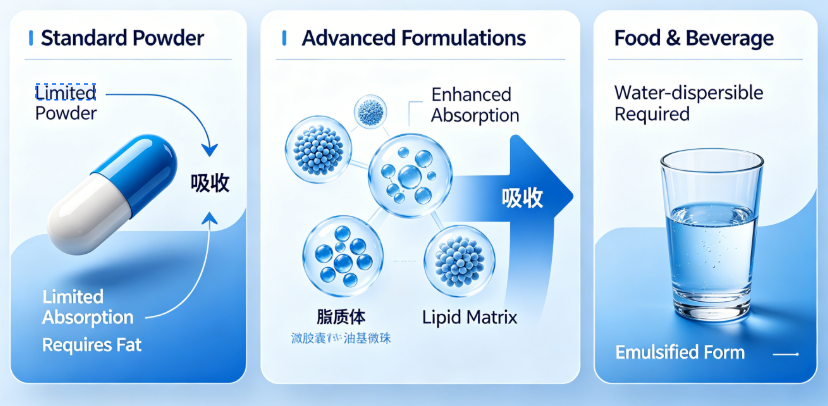
Standard spray-dried lycopene antioxidant powder in a capsule has limited absorption because lycopene needs dietary fat present in the gut to be taken up efficiently. This is why lycopene from cooked tomatoes with olive oil — the Mediterranean diet pattern — absorbs better than lycopene supplements taken on an empty stomach.
For supplement formulators, this means the delivery format matters as much as the lycopene concentration. Microencapsulated lycopene powder in a lipid matrix, oil-based beadlets with MCT or soybean oil carriers, and liposomal formats all address this limitation to varying degrees. A product using standard powder at 10 mg per serving may deliver meaningfully less active compound to circulation than a lipid-matrix beadlet format at the same stated dose.
For food and beverage applications, lycopene’s fat-solubility also affects how it disperses in the final product. Water-based beverages need emulsified or water-dispersible lycopene preparations rather than standard oil-soluble powder — an important spec distinction when talking to suppliers about intended application.
Where lycopene powder actually gets used
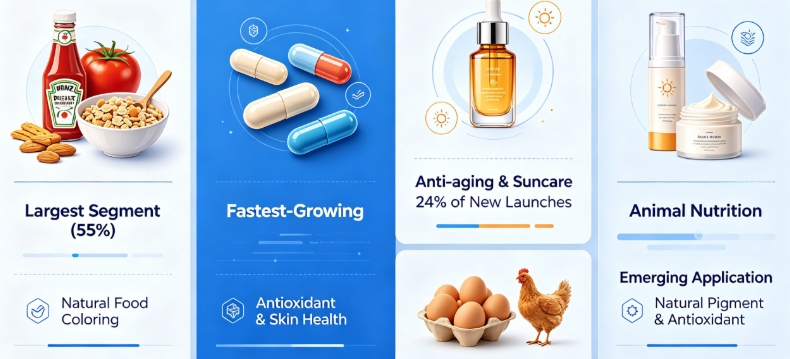
Food is the largest application segment, accounting for around 55% of global lycopene powder volume. Natural food coloring is a significant driver — as manufacturers move away from synthetic red and orange colorants, lycopene offers a clean-label alternative with a favorable regulatory profile in most major markets. Tomato-based sauces, soups, functional snacks, and fortified breakfast cereals all use lycopene for both color and nutritional label value.
Nutraceuticals are the fastest-growing segment. Lycopene supplement products are well-established in the US and European markets, predominantly as softgels and capsules targeting antioxidant and skin health positioning. The lycopene for skin health angle is particularly active in Asia-Pacific markets, where it appears in ingestible beauty supplements alongside ingredients like collagen and astaxanthin.
Cosmetics is smaller but growing quickly. Lycopene’s antioxidant properties make it relevant for anti-aging serums, suncare formulations, and skin-brightening products. Around 24% of new active ingredient launches in anti-aging categories now include lycopene or tomato-derived complexes. Water-dispersible grades are needed for most cosmetic applications since standard oil-soluble powder does not incorporate cleanly into aqueous bases.
Animal nutrition is an emerging application — lycopene shows up in premium pet food and livestock feed formulations as a natural antioxidant and pigmentation agent, particularly for poultry where carotenoid content affects egg yolk and skin color.
Sourcing specs worth specifying in your purchase order
Purity first. HPLC-verified lycopene content at 5%, 10%, or higher concentrations depending on application — UV spectrophotometry gives different readings than HPLC and the two methods are not directly comparable. Always confirm which analytical method was used.
Residual solvent testing matters for hexane-extracted natural lycopene. EU and US pharmacopeial limits for hexane residues in food ingredients are strict. Supercritical CO2 extracted material avoids this entirely but comes at a cost premium. Knowing the extraction method before ordering prevents compliance issues.
Stability is a genuine challenge with lycopene. The compound degrades under heat, light, and oxygen exposure. Proper packaging — nitrogen-flushed, light-blocking, moisture-barrier — extends shelf life meaningfully. A supplier who cannot specify storage conditions and guaranteed shelf life is not adequately characterizing their product.
Color specification by batch is a useful quality indicator. Lycopene powder color consistency reflects both purity and storage integrity. Significant color variation between lots points to raw material inconsistency or handling issues.
We supply lycopene powder with complete COA documentation and clearly defined product specifications. Sample requests and quotes are available directly from our sales team.